


Concluding S5LECT project new opportunities arise
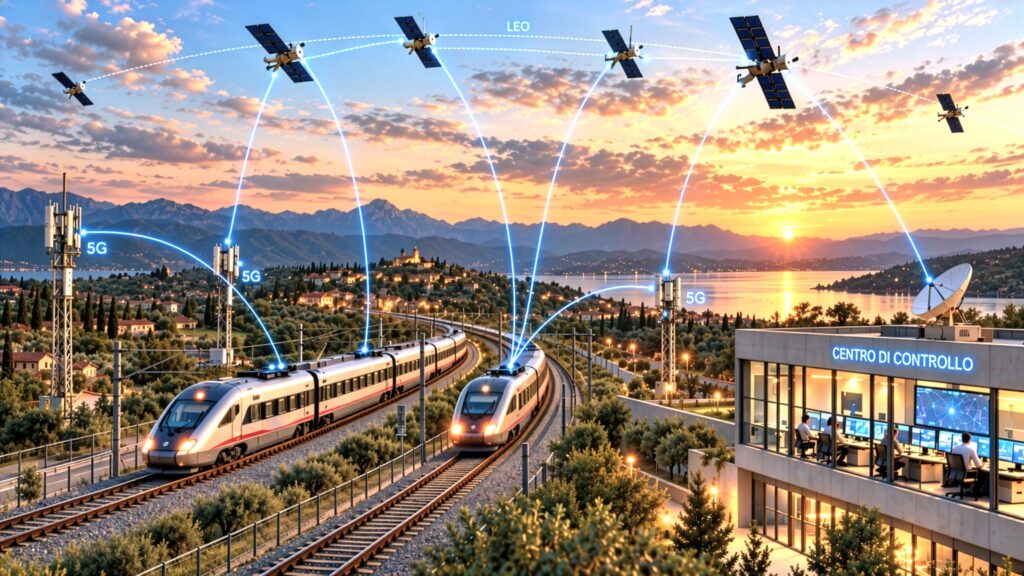
After years of 5G operative services, new LEO Satcom constellations have emerged – backed by billionaire investments – to expanding coverage and capacity of terrestrial networks. This scenario is incentivising cellular and LEO Satcom operators to work together more intelligently, reliably, and securely.
LEO Satcom – combined with cellular networks – represent a cost-effective solution to bridge coverage gaps and improve resiliency, reducing reliance on ground infrastructures whereas telecom traffic is not sufficient to justify dedicated networks.
Proprietary satellite terminals, with limited interoperability, that instead is a fundamental requirement for the standard ERTMS system, are no more necessary. In fact, LEO Satcom have recently embraced the 3GPP standards for D2D direct-to-device communications, in which satellites communicate directly with standard user equipments.
These telecom frontiers open to new solutions for the future of railway communications, including the FRMCS, as demonstrated by S5LECT project, funded by EUSPA and led by SNCF Réseau in a consortium with Hitachi Rail, Radiolabs and other partners. LEO satcom in conjunction with public mobile networks allow to reduce investments, lead time, civil works impacting on train circulation, energy – lowering CO2 emissions – thus contributing for deploying and operating the new standard 5G-based FRMCS network, the successor of the obsolete GSM-R network.
At the final event of the S5LECT project – held October 8th, 2026, at Hitachi Rail in Vélizy – project’s main results were shown, including field trials and laboratory simulations performed by the end-to-end LEO satcom emulator developed by Radiolabs in collaboration with its associated laboratory at University of Roma Tor Vergata.
The results have clearly confirmed the suitability of LEO satcom – already operational – and with further constellations to become operational – including the European IRIS² – a new telecom ecosystem will be available for the FRMCS. That scenario was anticipated by Radiolabs in 2015 when – first in Europe – had developed and validated a multi-bearer satcom and cellular platform on the railways lines in Sardinia with Ansaldo STS (now Hitachi Rail STS) and RFI – laying the groundwork for the use of public networks in anticipation of GSM-R obsolescence.
Since “the journey continues” as stated at the S5LECT event in Velizy, Radiolabs is now focusing its research on AI techniques, to gathering a comprehensive data set of LEO satcom performance in operational scenarios. These data – once categorised – will be the basis for the training AI-driven trusted multi-bearer networks using non-trusted public networks.
Radiolabs is also involved on developments of hi-fidelity simulation and validation tools to assess the performance of multi-bearer platforms without relying on extensive and not exhaustive tests on field. LEO Satcom and 5G represent a viable alternative also for the wireless networks as an alternative to the cables for connecting central posts with the numerous wayside object controllers along the railways lines.
